

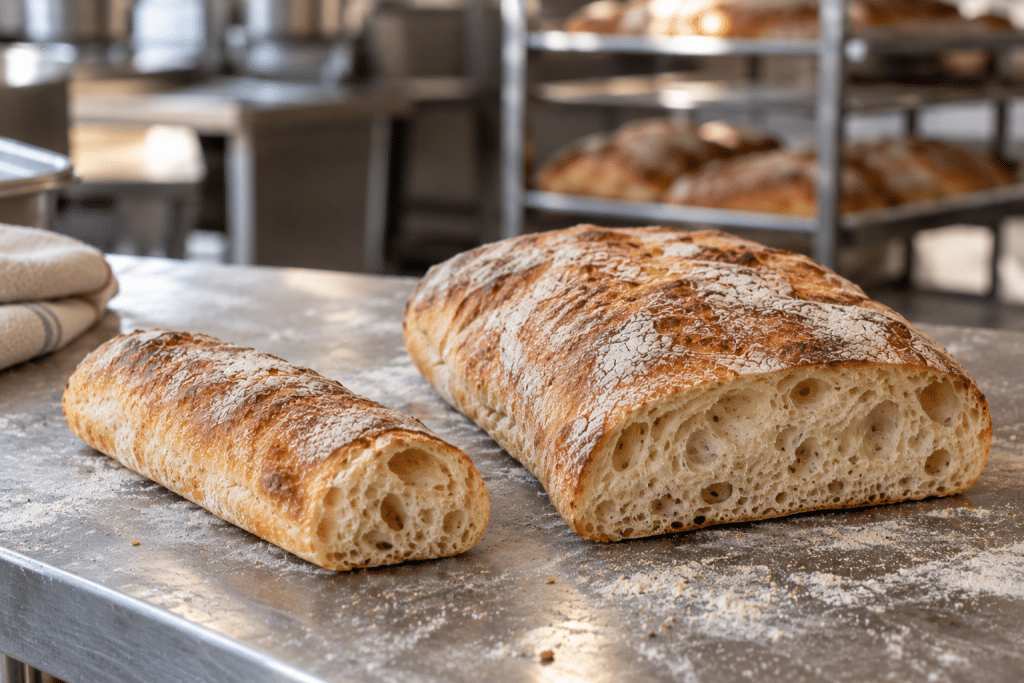
At a Glance
Key Takeaways
- Rolls simplify portion control and sandwich assembly.
- Loaves provide more flexibility for custom slicing and multiple menu uses.
- Packaging, press size, and plate presentation can determine the best format.
- Food cost should be evaluated using finished usable portions, not unit price alone.
Ciabatta Rolls Vs Loaves: The Short Answer
Choose ciabatta rolls when portion consistency, fast assembly, and individual presentation matter most. Choose larger ciabatta loaves when the kitchen wants flexible slicing, multiple portion sizes, crostini, or shared applications. Neither format is inherently better; the right choice depends on prep workflow, menu size, and waste control. For professional kitchens, the useful question is not only what the bread is, but how its shape and texture affect prep, service, and the finished menu item.
Rolls vs. loaves
| Decision factor | Individual roll | Larger loaf |
|---|---|---|
| Portioning | Highly repeatable | Flexible r |
| Prep labor | Lower | Requires slicing |
| Waste risk | Low if size fits menu | Depends on cutting/yield |
| Menu flexibility | Focused | High |
| Catering count | Easy | Requires portion planning |
The Core Difference: Fixed Portion vs. Flexible Portion
An individual roll arrives as a naturally defined serving. That can simplify training because employees do not need to estimate length or weight every time they build a sandwich. A loaf gives the kitchen more control but also introduces a cutting step.
The operational question is whether that flexibility creates value. If every sandwich is supposed to be identical, a roll may reduce variation. If one loaf supports sandwiches, crostini, and bread service, a larger format may be more efficient.
When Ciabatta Rolls Make More Sense
Rolls are useful for cafés, delis, breakfast programs, catering boxes, and grab-and-go items that need a consistent individual footprint. They can also simplify packaging because the kitchen knows the approximate finished sandwich dimensions.
Round or oval rolls may fit certain menu concepts better than rectangular loaves. The visual shape can influence how the sandwich reads on the plate even when the bread formula is similar.
When a Ciabatta Loaf Makes More Sense
Loaves are useful when the kitchen wants to control the exact portion, create larger sandwiches, cut smaller tasting portions, or use the bread across multiple menu positions.
A loaf can also reduce the need to stock many individual sizes, but only if the kitchen can slice it consistently. Poor cutting discipline can erase the theoretical flexibility by creating uneven portions and waste.
Panini and Press Considerations
An individual roll that fits the press can speed service because no trimming is required. A loaf allows the kitchen to cut a size matched to the press, but that adds labor and may create end pieces.
Test the compressed dimensions as well as the raw dimensions. Bread can spread under pressure, and a sandwich that technically fits the press may still become awkward after heating.
Catering and Grab-and-Go
For boxed lunches and prepared displays, individual rolls support consistent appearance and fast counting. Larger loaves can work for platters when sandwiches are cut into halves or smaller portions.
The key is repeatability. Catering often magnifies small inconsistencies because dozens of sandwiches are assembled at once.
Waste and Yield
Do not compare formats only by price per piece or loaf. Compare how many finished sellable portions the kitchen gets, how much trimming occurs, whether end pieces are usable, and how much bread remains after service.
A slightly more expensive individual roll can be operationally cheaper if it eliminates cutting waste and speeds assembly. A loaf can be more economical when the kitchen can use every part efficiently.
Il Forno Ciabatta Formats
Il Forno’s catalog includes several ciabatta products that can support different portion strategies, including Ciabatta, Ciabatta Square, Ciabattini, Ciabatta Oval, Mezzo, Grande, and Round Ciabatta.
Use the decision framework above to narrow the format first, then compare the relevant Il Forno ciabatta products in the catalog for the specifications and shapes that best fit your menu.
For Foodservice Businesses
Choosing ciabatta for a menu?
Review the relevant Il Forno catalog formats, then use the quote inquiry form to discuss the application, expected volume, product specifications, samples, account requirements, and current route eligibility.
Discuss Ciabatta for Sandwiches